How to Create a Strong Password You'll Never Forget: The Romance of Cryptography
121
February 26, 2026
Daniel LuFull-Stack Engineer | Content Creator
To appease machines, we've forced ourselves to memorize gibberish. "123456" is still the world's most common password. This article teaches you how to use humanity's storytelling talent to build an ultimate password that is unbreakable yet unforgettable.
Categories:Popular Science
Recall the agonizing struggle you face every time you register for a new account.
The red text on the website relentlessly dictates: "Password must contain uppercase letters, lowercase letters, numbers, and special characters."
So, you sigh, take your dog's name, add your birth year, append an exclamation mark at the end, and concoct a monstrosity like
Wangcai1990!.You think it is very secure .
But unfortunately, facing modern hackers' dictionary attacks and top-tier graphics cards (GPUs) performing hundreds of billions of brute-force attempts per second, cracking this password is as easy as tearing a piece of wet paper.
What's even sadder is that three months later, you yourself have forgotten it.
We Are Fighting Machines the Wrong Way
The biggest mistake humans have made in cryptography is trying to force ourselves to think like computers .
Computers love absolute randomness, strings of characters with no patterns, such as
hF8$pK2@q.
But the human brain is not a hard drive; our neurons store information through "stories, visuals, and logical associations" . Forcing humans to memorize meaningless gibberish is a recipe for disaster.As a result, we either revert to incredibly dangerous weak passwords like "123456", or we write down our complex passwords on sticky notes attached to our monitors (which is equivalent to leaving the front door unlocked).
In truth, the highest realm of cryptography does not require you to become a cold machine, but rather a poet full of imagination .
Length Crushes Complexity: The Dimensional Strike of Passphrases
In cryptography, the golden standard for measuring password strength is called "Information Entropy" . You can understand it as "the degree of the unknown that a cracker must face".
Here is a highly counter-intuitive mathematical truth: The length of a password contributes far more to information entropy than the complexity of its characters.
An 8-character complex password containing all special symbols might only take a computer a few days to brute-force.
However, if you string together four completely unrelated simple English words, like
correct horse battery staple (length 25), the information entropy it generates is enough to keep a supercomputer calculating for millions of years.This is the ultimate answer to the paradox of memory and security: The Passphrase .

Click to enlarge
Turn Your Password into a Dreamscape
To create a flawless passphrase, you only need to use the ultimate talent humans have evolved over millions of years: Visual Imagination (also known as the Method of Loci).
Do not use famous quotes, and do not use song lyrics—those are all in the hackers' brute-force dictionaries. You need to create a dreamscape that is highly absurd, completely illogical, yet possesses immense visual impact .
Follow me through these three steps:
1. Randomly pick four nouns
Close your eyes and think of four completely unrelated things.
Remember: No associations. For example, don't use "sun, moon, stars", because they are semantically bound.
Try this:
penguin, waterfall, lamp, invoice.2. Create an absurd visual scene
In your mind, forcefully piece these four words together:
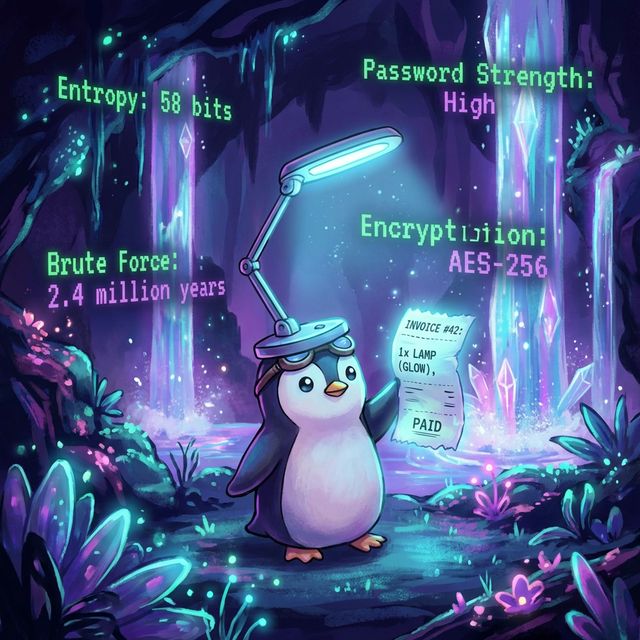
A penguin is standing under a massive waterfall , balancing a glowing desk lamp on its head, while proudly holding up an invoice in its flipper.
Pause for three seconds and vividly imagine this scene.
You will find that the more bizarre and absurd an image is, the firmer your brain remembers it. Even five years from now, you will still recall that penguin holding an invoice.
3. Add a touch of your exclusive mark
To turn these four words into a connected password, use a separator only you know. Not a simple space, but perhaps: a hyphen, a period, or even an underscore.
Then, add a two-digit number tied to a private memory (like your seat number in elementary school).
Your ultimate password is born:
penguin-waterfall-lamp-invoice-17To humans, this is just a cute fairy-tale image that you can effortlessly retrieve from the depths of your memory;
But in the eyes of a hacker attempting to crack it, this is a Wall of Sighs composed of countless combinations with astronomically high information entropy.
Conclusion
In the digital age, protecting privacy and security shouldn't be a painful self-torture.
You don't have to rote-memorize those counter-intuitive strings of gibberish. Leave the tedious generation and verification work to excellent password managers (like Bitwarden or 1Password). And you, you only need to carefully guard an absurd story, woven by your imagination and known only to you.
This is a unique romance we possess when humanity stands against cold machinery.
This article is an original piece by the iknowabit team. Using a geeky perspective to decode the science behind everyday life.